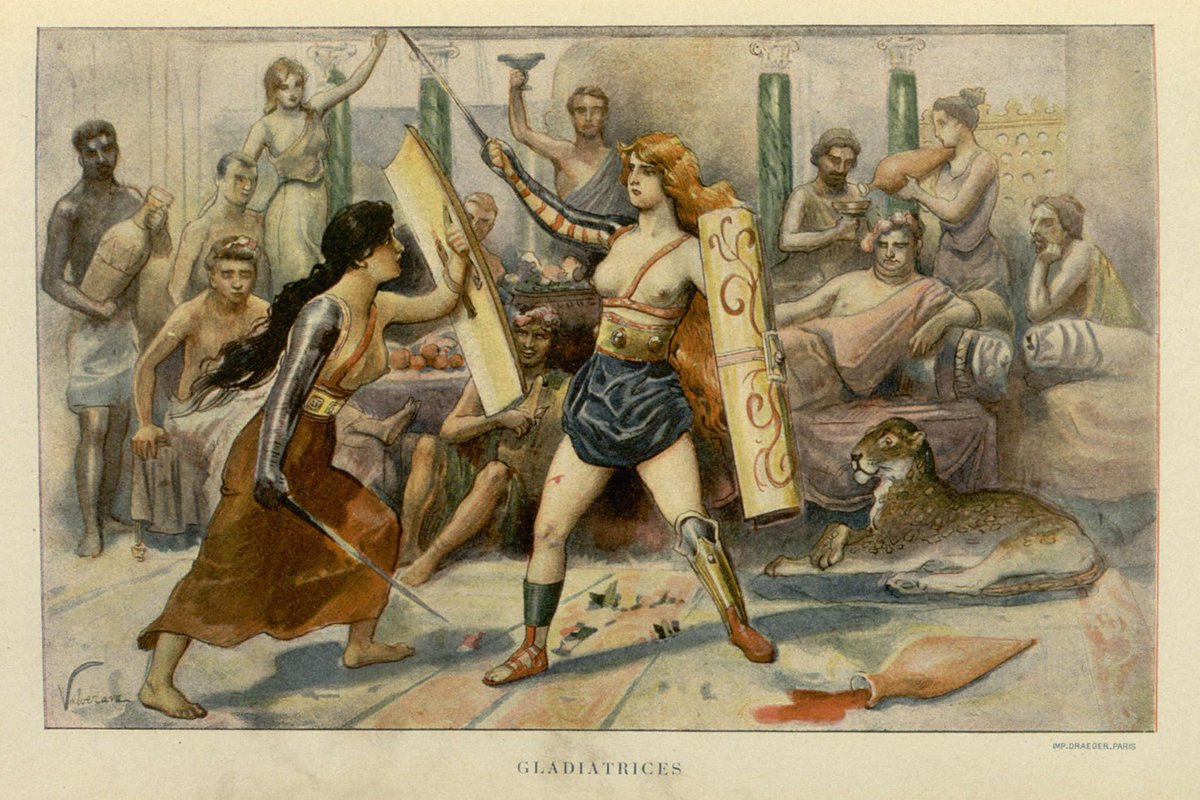
Juvenal 6
Introduction:
Juvenal’s 6th Satire is famous for its misogyny. In this module, we highlight key passages, suggest useful companion texts to pair with the Satire, and offer a set of discussion questions focusing on misogyny in the Imperial Roman context. A sample lecture and PowerPoint is included.
Juvenal’s 6th Satire is an advanced and unpleasant text. It’s useful to show the elements and range of Roman misogynistic thinking (women’s bodies, behaviors, sexuality). There’s a shock value in reading some of J’s most obscene passages, e.g., the description of Messalina.
Satire 6 is also about male effeminacy and men’s failure to control women, and so speaks to regimes of masculinity in Roman thinking (see also Satire 2).
You could also teach Juv. 6 in a larger module on Satire as a Roman literary form, or in an advanced Latin class, and read with Horace, Persius, Lucilius.
Primary Sources:
“Juvenal: Satire 6” in Chiara Sulprizio, Sarah Blake, Gender and sexuality in Juvenal’s
Rome: Satire 2 and Satire 6. Oklahoma series in classical culture, volume 59. Norman: University of Oklahoma Press, 2020.
(assign either all of Satire 6 = pp. 65-95; or lines 1-62, 78-135, 286-345, 435-456, 474-507, 627-661) (1-3)
Suggested companion texts:
Medical texts on female bodies and liquids
Semonides, fr. 7, on a catalogue of types of women
Pliny, NH 10.172, on Messalina’s sexual competition with a sex worker
Secondary Sources:
Blake, “Introduction” in Sulprizio 2020 (pp. 13-16, 20-24, 27-35) (1-3)
Richlin, Amy. “Invective Against Women in Roman Satire.” Arethusa, vol. 17, no. 1, 1984, pp. 67–80, https://www.jstor.org/stable/26308604 (2-3)
Gold, Barbara K. “‘The House I Live In Is Not My Own’: Women’s Bodies in Juvenal’ Satires.” Arethusa, vol. 31, no. 3, 1998, pp. 369–86, https://doi.org/10.1353/are.1998.0013. (2-3)
Multimedia Resources:
Onion, Rebecca. “‘It Is a Miracle That Employers Don’t Murder More Secretaries” .’” Slate, 17 Aug. 2018. (1-3)https://slate.com/human-interest/2018/08/the-1945-book-what-men-dont-like-about-women-excerpted-in-esquire-makes-for-a-jaw-dropping-read-in-2018.html. (1-3)
Activities:
Lecture notes (Sulprizio) (1-3)
Juvenal 6 Satire lecture notes with analysis of Gold 1998
Discussion/Reading Questions
- What are Juvenal’s complaints about women? What stereotypes/images does he invoke?
- What about men? About marriage?
- How is it that Roman women and men came to be like this, according to Juvenal?
- What cultural work does this kind of poetry (satire) do? How do you think a Roman reader/listener would respond to this poem?
- What historical contexts inform the production of this poem? Or, more simply, why do you think Juvenal wrote this at the moment he did?
- Is there such a thing as a good woman in Juvenal? Is his misogyny distinctive to his world or universal?
- Can women produce satire? Why or why not?
- What similarities, if any, do you see between Juvenal’s “advice” to Postumus to avoid marriage, and contemporary ideas about women, men, and relationships?
Slideshow
Juvenal, Satire 6 (aka “Women, you can’t live with ’em…”) Powerpoint Presentation https://docs.google.com/presentation/d/1z-1sGKpqgByMOEPLQlUInPt2tzQ1q23M/edit?usp=sharing&ouid=107459944983329366494&rtpof=true&sd=true (1-3) (Sulprizio)